From the original article on no knead bread,
http://www.nytimes.com/2006/11/08/dining/08mini.html?_r=1&oref=slogin
came this website http://aresrocket.com/bread/ which better-ed the recipe.
Monday, September 24, 2007

Tuesday, August 21, 2007
Sambal Kangkong
 I actually did this with spinach but of course it's more well-known with kang kong. The pounding crushes the ingredients and releases fragrant oils that aren't released if they are 'cut' using a food processor or blender. This is the key to nonya cooking - the humble pestle and mortar. But of course, in this modern day and age, who has the time to pound pound pound? For me however, it is therapeutic - pounding away my anger and frustrations. But it took me a good half hour!
Ingredients
2 sticks of lemongrass, roughly chopped
Half a white onion (optimally, use 3 shallots), roughly chopped
2 cloves of garlic, crushed
1 thumb-sized piece of ginger, roughly chopped
2 tbsp dried shrimp (hay bee)
4 dried chillies, soaked in hot water until soft and deseeded (This gives only a slight spiciness, go up to 10 chillies if you think you can take it!)
2 tsp balachan
1 tsp sugar
3 tbsp cooking oil
1/4 cup water
1 big bunch of kang kong
Method
1) Pound all the ingredients, going in the order given in the ingredients above, omitting the sugar, cooking oil and water.
2) In a wok, heat up the cooking oil. This may seem like a lot but the sambal will soak it up. Fry the pounded ingredients using a medium heat until the it has a shiny and slightly oily texture. Watch the fire as it burns easily!
3) Add the water. Beware as this will splatter and produce a lot of steam! Turn down the fire. Stir until the water is incorporated and it is no longer watery. Add slightly more water if it becomes too dry.
4) Add the tsp of sugar. If necessary, add salt. (usally this is not necessary as the balachan is salty enough but everyone's taste differs). Add the bunch of kang kong and stir until the vegetable is cooked.
5) Serve immediately with freshly steamed rice.
Thursday, August 16, 2007
Chicken and aubergine casserole in a bean paste sauce

Feeling like an all-in-one casserole, and since I finally had my favourite veg, it was either cooking it separately and spending 1/2 pounding a sambal, or throwing it together with the chicken. Guess which option won? :)
Ingredients
1 aubergine, sliced
8 -10 chicken thighlets
1 handful wolfberries (optional)
1 thumb sized ginger, skinned and cut into small slices
2 cloves garlic, crushed and chopped
1/2 cup of water
Marinade
2 tbsp spicy bean sauce (I used Lee Kum Kee for mapo toufu)
1 tbsp dark soya sauce
1 tbsp light soya sauce
2 tsbp chinese rice wine
1 tbsp sesame seed oil
1 tsp fish sauce
1 tsp sugar
Method
1) Marinate chicken with the marindate ingredients. Set aside for at least 1 hour. If you can do so overnight, all the better.
2) In a casserole dish, assemble by placing aubergine slices at the bottom and sides of the cassarole, before pouring in the chicken with the marinade. Pour in the water. The water level should not be too high, about 3/4 way up the cassarole otherwise it may bubble over in the oven. You may top up just a bit if necessary, as water helps the chicken and aubergine to cook.
3) Add the garlic and ginger and finish off by placing some aubergine slices on top of the chicken.
4) Bake at 180 deg C for 30 minutes.
5) Serve with steamed rice.
Thursday, August 09, 2007
Curry chicken in Pita
 Been looking for different staples to try out since I'm a bit sick of bread and rice. So came across wraps and pita bread in Cold Storage and thought, hey why not. It would go very well with my alfafa sprouts in the fridge.
Ingredients
1 packet of pita bread (5 pitas inside)
300g minced chicken
1 tbsp soya sauce
1 tsp tumeric powder
1 tsp cumin powder
1 tbsp curry powder
pepper to taste
1/4 cup shredded chedder cheese
Alfafa sprouts
Lettuce
Cooking oil
Method
1) Marinate the minced chicken with the soya sauce, tumeric, cumin, curry powder and pepper for at least 20 minutes.
2) Fry the minced chicken and be sure to try to separate it as much as you can, which tends to be harder than with minced pork or minced beef. Once cooked, remove to a plate to cool slightly.
3) Warm up the pita breads by brushing them with oil and then popping them under a grill or on a pan. Turn over halfway.
4) While still hot, cut a slit at the top. Fill it up with the lettuce, alfafa, chedder cheese and chicken.
5) You can flash it under a grill again just to melt the cheese. Otherwise, if you don't like 'warm' lettuce and alfafa, don't fill in the pocket but serve it on the side as a salad.
Saturday, August 04, 2007
French Toast 2
After the french toast experience at HK Cafe last week, I decided to resurrect my French Toast experiments. A summary of what I did last time:
Experiment #2


Experiment #1
Coat bread with egg wash, and then dip in corn flour and pan fry.
Experiment #2
Coat bread with egg wash, then dip in normal flour and pan fry.Between these 2, the different isn't entirely discernable. With corn flour, the flour amalgamates easily with the egg wash, making the coating slightly crunchy but smooth. With plain flour, the flour acts as a separate coating by itself and you can still see the flour bits on the bread, not so pretty. However, it's most crispy than corn flour, probably because it doesn't amalgamate with the egg.
Experiment #3
Combine the corn flour and normal flour into the egg and beat. There will be lots of little lumps.This was the worst of the lot, didn't make it any more crispy, looked ugly (uneven finish) and just made the bread a bit 'tough' to chew on.
Outcome:
So I think the best compromise is still to coat with corn flour. Pretty and yet slightly crispy.
This time I did something different.
Ingredients
6 slices of bread
4 eggs
3 tsp of cornflour
2 tsp of cinnamon
Method
1) Combined 1 teaspoon of cornflour with 1 egg.
2) Buttered the bread on both sides, using the idea from Bread & Butter pudding
3) Turn the heat up on high otherwise the toast will never brown. While I fried 1 slice (cut diagonally into 2), I let the next one soak in egg.
4) Fry until golden and serve with condensed milk or honey or both! :)


Friday, July 13, 2007
Chinese paella
I'm a cooking programme junkie. Lately, I watched an old episode of Jamie Oliver in Oliver's Twist and watched him as he brought a Brazilian friend home and tried to prepare authentic Brazilian stew - with a Jamie twist, of course. In particular, 1 dish actually reminded me Chinese cooking. He started off with Brazilian sausages (which look surprisingly like lap cheong), fried them off, then poured in some spare ribs for browning and topping off with other liquids. I also watched a recent episode of Kelly Kwong and saw her fry fried rice, which I've not done for a long time simply because I've not had leftover rice for a long time ever since I discovered the microwave rice cooker. Last night, I watched an episode of Chef At Home and saw Michael Smith prepare something involving basmati rice.
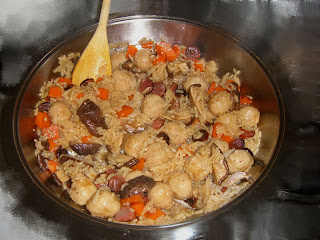
Suddenly I felt inspired - I dusted off my old paella pan and this is that I did:
Ingredients
1 packet chicken balls (too lazy to go and debone chicken thigh and cut into cubes, and don't like using chicken breast because it's very dry)
1 carrot, diced
8 dried shitake mushrooms, soaked in 1/2 cup of hot water
1 large onion, diced
3 cloves of garlic, crushed
1 cup of rice, washed and drained
2 lap cheong, cut into circles
oil for frying
Method
1) Pour the oil into a heated paella pan. Fry off the lap cheong. Once the oil has started to melt and ooze out, add the onions and fry until soft. Add the carrots and fry briefly for about a minute.
2) Drain the mushrooms and slice up. Reserve the water from soaking the mushrooms.
3) Add the crushed garlic, rice and mushrooms to the pan, and briefly fry to incorporate.
4) Pour back the water used for soaking mushrooms, and add another 1 and 1/2 cups of water (ie total 1 cup rice = 2 cups water). Pat down ingredients without stirring the rice too much or the grains will break. Bring to boil.
5) Cover and leave on a slow simmer for about 20 mins until the water has been absorbed and the rice is cooked and fluffy.
6) Serve immediately in the paella pan.
Thursday, July 12, 2007
Scones
 Boss made some very nice fresh scones to surprise us one morning. Here's the recipe - looks super easy!
Prep time: 20 min
Cook time: 15 min
Ready in: 45 min
Ingredients (makes 8)
1 3/4 cups (220g) all-purpose flour
4 teaspoons (15g) baking powder
5 tablespoons (70g) unsalted butter
5 tablespoons (60g) white sugar
2/3 cup (160ml) whole milk
1/2 cup (70g) currants
1 egg yolk, beaten
Directions
1) Preheat oven to 400 degrees F (200 degrees C). Lightly grease a baking sheet or line with baking parchment.
2) Sift flour and baking powder into a medium bowl. Rub butter and sugar into flour to form a fine crumble. Make a well in center, and add milk and currants. Knead gently together, being careful not to over mix. Dough will be sticky.
3) On a generously floured surface, roll out dough to 3/4 inch thickness. Stamp out 2 1/2 inch rounds with a plain pastry cutter. Transfer to prepared pan, and brush tops with egg yolk. Allow to stand for 15 minutes.
4) Bake in preheated oven until risen and lightly golden on top, 12 to 15 minutes. Remove to a rack to cool.
Variation: My scones (see picture) were made by substituting the raisins with bits of apple (approx 1/2 a big apple) which resulted in increasing the cooking time by about 3 minutes.
Saturday, July 07, 2007
Beef and sweet potato broth
 In my new stew craze, I've been experimenting with different slow cooker recipes. Here's the one I tried today which altho didn't turn into a stew, became instead, a nice thick broth. Notice I use the word 'broth' rather than 'soup', because that's exactly what it is.
Ingredients
500g stewing beef, cubed
1/4 cup flour
1 tbsp 5 spice powder
1 tbsp dried basil or sage
1 large white onion, finely diced
1 carrot, cubed
1 sweet potato, cubed into smaller chunks (approx 1 inch cubes. This is impt so that they will actually start to 'melt' and provide the thickness to the broth)
2 handfuls barley
1.5l pork bone stock or chicken stock
2 tsbp rice wine (optional)
2 tbsp worchestershire sauce (optional)
1 handful soyabeans (I put this in a bag so that I could fish it out later as I don't really like eating beans but you can always leave it in)
Oil for frying
Salt and pepper to taste
Method
1) To the flour, add the basil or sage, 5 spice powder and salt and pepper. Mix well. Coat the beef cubes evenly.
2) Add oil to a pan and brown the beef cubes taking care not to crowd the pan. Do a batch at a time until nicely browned on all sides. Remove and drain.
3) Add more oil to the pan and add in the onion, carrots and sweet potato. Briefly fry until onion softens.
4) Pour the vegetable mix into a slow cooker, together with the beef. Add the soyabeans, barley and stock. Pour in the remaining flour used to coat the beef.
5) Once the broth comes to a boil, skim off the foam and any floating oil. Leave to slow cook for at least 2 hours.
6) After 2 hours, pour in the rice wine and worchestershire sauce. It is ready to be served after another 10 minutes of simmering. At this point, check for seasoning and add salt and pepper if needed.
7) Leave it to simmer for up to 4 hours so that the beef becomes really tender, and the sweet potatoes and barley melt to produce a thicker gruel. It can also be cooled down and kept in the fridge after the initial 2 hours, and reheated the next day after skimming off the fat. This leaves time for the tastes to infuse overnight.
Saturday, June 30, 2007
Fried calamari rings
Was watching a Korean food programme on squid. Learnt interesting facts: squid has more protein than beef. It is very low in fat. It is a rich source of taurine (anti-ageing) and selenium (anti-oxidant). Squid ink is also good and like black beans and black sesame seeds, is supposed to be good for the heart and asians believe it is good for the kidneys and liver.
Here's a simple recipe which is light and easily prepared.
Ingredients
Squid, prepared and cut into rings. The tentacles can either be whole or cut in half.
Milk
Egg
Flour seasoned with salt, pepper
Method
1) Prepare the squid. Soak in beaten egg with a splosh of milk.
2) Coat with the seasoned flour.
3) Deep fry until golden brown and crispy.
4) Serve with mayo or sweet chilli sauce.
Sunday, June 17, 2007
Curry Pork-ettes in a Hurry
 After my chicken nuggets, I liked the idea but found chicken breast too dry. I decided to give it a go with pork. The nice thing about pork is that it's slightly fatty, and even if you trim away the obvious fat, the grain of the meat itself still has little bits of fat which keep the meat moist. After cooking, even without oil, you'll see the oil and juices bubbling out and you'll know it's nice and moist inside.
With my trusty new bottle of 5-spice, I decided to try something new. I added curry powder for added kick but accidently ended up pouring half the bottle in. And hey, what did you know, it actually worked out better!
Ingredients (serves 2)
300g pork loin, cut up into nugget-sized chunks. Try to make them as evenly sized as possible so that the cooking time will be the same.
1 egg, beaten
2 tsp mustard
1 tsp salt
1 tsp 5 spice powder
1 tsp cinnamon
1 tsp cumin
1 tsp tumeric
5 tbls curry powder
dash of pepper
crackers, crushed (approx 6 or 7 'soda' biscuits or you can use other types of crackers e.g. Ritz, Jacobs, etc)
Method
1) Pour the beaten egg into a shallow plate. Add the salt and mustard and stir well. Place the pork chunks in the egg and stir well. Leave to marinate for at least 10 mins
2) Put the crackers into a ziploc bag and crush using a rolling pin. Add all the rest of the dry ingredients and toss well.
6) For that added crunch, serve with deep fried curry leaves.
2) Put the crackers into a ziploc bag and crush using a rolling pin. Add all the rest of the dry ingredients and toss well.
3) Place pork chunk into the ziploc bag. Shake well to coat the pork properly.
4) Arrange on baking tray lined with greaseproof paper.
5) Bake at 200 deg C for 15 mins or until cooked (depending on the size of your pork nuggets)
6) For that added crunch, serve with deep fried curry leaves.
Subscribe to:
Posts (Atom)

-
 Tried this with chicken wings, only because I love wings so much. I changed the cooking times to 180 deg C at 20 minutes covered, then 10 mi...
-
This mantou dough XiaoHong uses a different method with single proof by adding the yeast AFTER the dough has been kneaded. Ingredients 50...
-
 Because I love beef soup so much, I just had to try a different style. After the pho attempt which essentially took the whole day to make, ...