Showing posts with label gelatine. Show all posts

Wednesday, September 06, 2023

Longan almond agar agar with evaporated milk

Since my attempts using milk in 2015 and the original 2009 to make almond jelly, I thought I'd try with evaporated milk because I had it in the cupboard and I don't often.

I've surmised that I like the texture of agar agar which is slightly chewy better than jelly which tends to come out rubbery rather than pillowy toufu-soft.


Ingredients and method are pretty standard. 1 tsp almond essence to 1 litre of liquid to 1 packet of Swallow brand agar agar - only that brand will work. Basically I used all the liquid from the can of evaporated milk and can of longan and topped up to make 1 litre. I didn't add any additional sugar because I used the liquid from the can of longan.

Recipe feedback 

Compared also the using milk with agar agar, the colour of the almond agar agar using evaporated milk is yellowish rather than white. Texture-wise, it's as firm as using milk but taste-wise, it's certainly a lot creamier.

Saturday, September 28, 2019

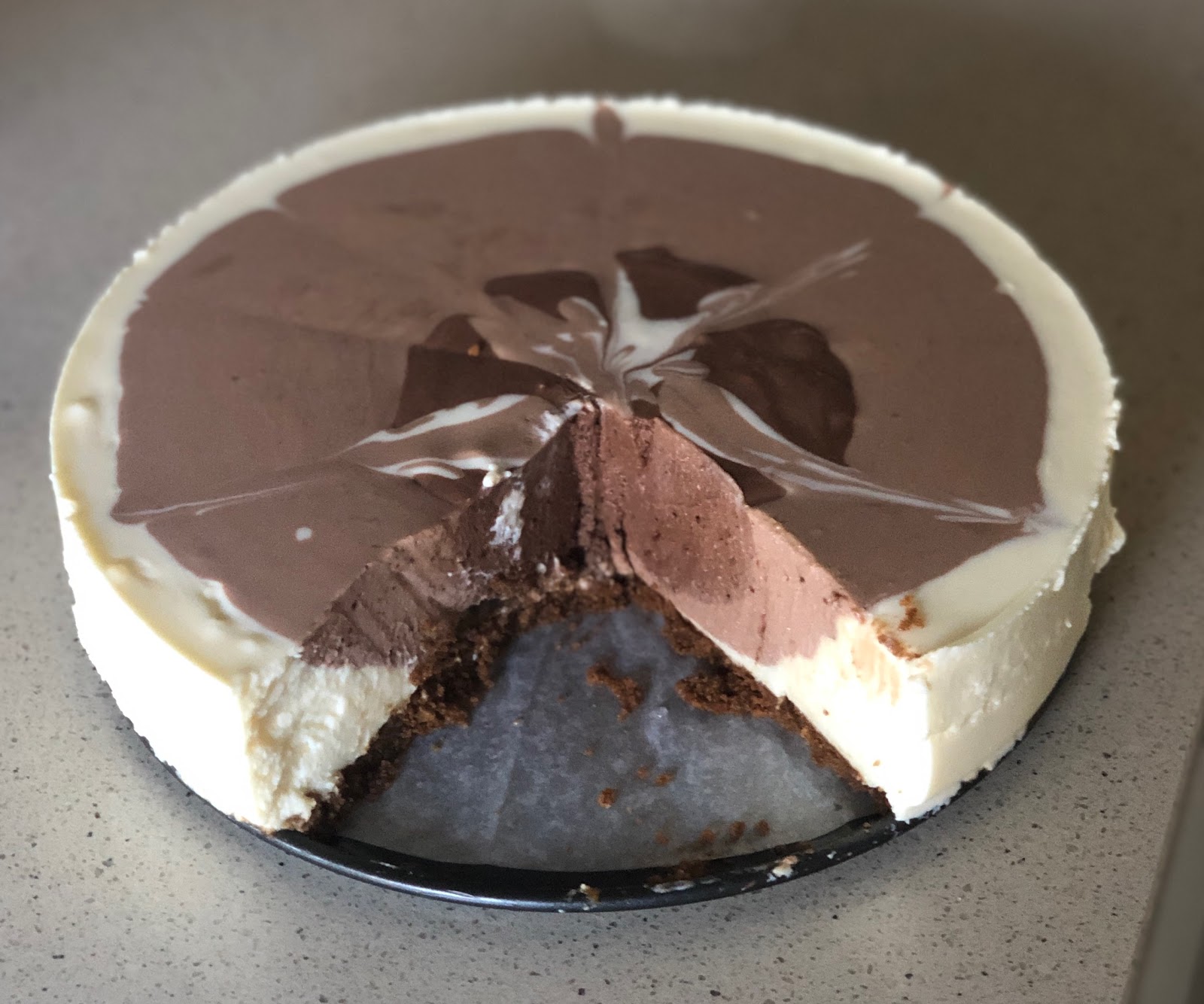
No-bake Chocolate mousse gradient cheesecake

From the first attempt which was the no-bake choc mousse ripple cheesecake, I decided to perfect my technique. I found the proportions in this first version excessive (e.g. 520g of double cream) which is what happens when you use maths. I decided to go with my gut feel and also what's available in the supermarket (e.g., I can buy a 250ml double cream bottle but would have to buy a large 500ml double cream and add 20g from a new packet). The measuring was also too fiddly and while I'm a perfectionist, I can live with less than equi-distant circles.


Ingredients (8 inch round tin)
15 ginger snap biscuits or similar sweet biscuit
2*250g blocks of Philly cream cheese, softened + 4 tbsp powered sugar
75g butter, softened
250ml double cream + 3 tbsp powdered sugar
cold 350ml milk + 4 tbsp powdered sugar
2 tbsp gelatine powder
5 tbsp cocoa powder

Method
1. In a food processor, process the biscuits until a fine crumb forms. Add the butter and chop till it forms the texture of wet sand.
2. To make the cheesecake base, line the bottom of a 8 inch springform tin with parchment. Oil the sides of the tin with butter. Pour in the sandy crumbs and press down with a spatula or the bottom of a glass. Press it in until the layer is flat. Leave in the fridge to firm up.
3. Sprinkle the gelatine powder onto the surface of the cold milk and leave it to bloom.
4. After about 5 minutes, microwave the milk for a minute (until warm to the touch) and whisk in the gelatine until no lumps remain.
5. In a clean food processor bowl, beat the philly with the powdered sugar until smooth. Pour in the milk and pulse until smooth. Pour into a big mixing bowl.
6. In the food processor bowl, beat the double cream with the powdered sugar until textured but not yet stiff. Pour into the cheese mixture and fold in. Set aside.
7. In a smaller mixing bowl, add a few tbsp of the batter and 3 tbsp of cocoa powder. Whisk until smooth and pour in more batter (total should be less than ⅓ of the total batter) until you attain a dark chocolate colour.
8. In a medium mixing bowl, repeat the method with the 2 tbsp of cocoa powder. Pour in the batter, this should be about half of the remaining batter. You would be left with the remaining half of the batter that has no cocoa (i.e. cream colour) in the big bowl. Store the big and medium bowls in the fridge for about 5 minutes to firm up slightly, otherwise the batter is too runny and the pattern will not be distinct.
9. Take the cheesecake base out from the fridge. Pour in the batter from the big bowl onto the base. Return to the fridge to chill for 5 minutes.
Looking much neater than my first attemp. Note how thick the batter in the centre is
10. Carefully pour the batter from the medium bowl from a height (5cm) onto the centre of the colour. This allows the batter to spread and fill slowly.
11. Pour in the final darkest colour in the small bowl. This batter is slightly thicker due to the high concentration of cocoa powder, so ladle it to fill the centre but do so slowly and carefully. Carefully use a palette knife to smoothen the top.
12. Drop the cake tin from a height of 5 cm to dispel big bubbles. If desired, swirl the colours with a palette knife.
After swirling
13. Return to the fridge to chill for at least 4 hours until firm. To unmould, run a knife around the edge of the tin to loosen from the side. (I forgot and the cake tore trying trying to dislodge itself from the tin!) To serve, use a cold knife and wipe the blade with a damp cloth after each cut.

Monday, October 29, 2018

Matcha panna cotta

Am trying to use up my matcha and this is the final dessert that I will be doing with matcha this time around. Am using gelatine sheets for the first time and I must say that it's easier to use than powder. With powder, there are always lumps but not so with gelatine sheets. Matcha however was a pain to use and without a chasen to whisk the matcha, it was a real pain to ensure no lumps while also ensuring that everything is blended into the water. Somehow a whisk just doesn't work as well, even though I've used my trusty tiny sauce whisk.

Interesting tit bit from JOC is that 2 sheets roughly equals 5g of powder and used to soft set 1 cup or 250ml of liquid.
https://www.justonecookbook.com/cherry-blossom-milk-pudding/

However from other sources, I know that cream and milk need more gelatine powder to set it. As such, my recipe is adapted from these 3 recipes below based on my preferences and the volume of my ramekins but the basic method and ingredients remain the same.

https://www.thelittleepicurean.com/2014/05/matcha-green-tea-panna-cotta.html
https://cookingwithdog.com/recipe/matcha-panna-cotta/
https://www.justonecookbook.com/green-tea-pudding/

Ingredients (makes 4 ramekins)
2 tbsp matcha powder
300 ml of milk
300 ml of cream
50g (1/4C) + 2 tbsp sugar
4 gelatine sheets
2 tbsp hot water
4 tbsp anko (3 tbsp - 40g)

Method
1) Sift the green tea powder. Prepare the ramekins by spraying non-stick spray on the sides.
2) Cut gelatine sheets into smaller strips. Soak gelatine strips in cold water for 5 to 7 mins (instructions from the packet). Fish out of the water and squeeze out additional water. Put into the 2 tbsp of hot water and stir until dissolved.
3) In a pot, bring the milk and cream to just under a boil. You should see small bubbles forming at the side of the pot. Do not boil.
4) Remove from the heat and add the sugar and stir until melted.
5) Add the dissolved gelatine and whisk until incorporated.
6) Make the matcha paste. Add 5 tbsp of the warm liquid to the match and blend until a paste forms.
7) Place the paste into a sieve and using a spoon or spatula, slowly blend the paste into the milk-cream mixture. Whisk to ensure that everything is incorporated.
8) Optional: transfer to a pouring jug to facilitate pouring. Otherwise, pour into the ramekins. Cover with cling film and leave to set in the fridge for 4 hours or best, overnight.
9) Unmould with a plastic knife if desired. Serve with a tbsp of anko each.


Wednesday, August 12, 2015

Almond jello

Since making my almond jelly (or more accurately, almond agar agar which sounds less cool), I've moved continents and discovered that agar agar is more difficult to locate here.

My experiments showed that full cream milk and agar agar are a no no, it becomes too firm. The best is half cream milk or equal parts full cream milk and water. To activate the agar agar, the liquid must come to a boil to dissolve the agar agar. However on cooling, it starts to harden. The texture is well, a bit firmer.

Gelatine produces a softer jelly but requires about 2 tbsp for 1 litre of liquid, bearing in mind that milk actually requires more gelatine. But gelatine powder has a strong aftertaste. I have tried gelatine leaves and even though there is no aftertaste, it just doesn't set the milk. Again, half fat or equal parts full cream milk and water seem to work best. The liquid cannot be boiled, so the best is to rehydrate the gelatine in water, then add to warmed liquid before turning off the fire. The liquid needs to be chilled for 8 hours otherwise it will not harden fully. Texture is jello.

Finally, almond milk works the best with gelatine, about 2 tbsp to 1 litre liquid. This produces the best texture, like tofu.

I've heard of using evaporated milk but have not tried.

Evaporated milk and gelatine:
https://bcdairy.ca/milk/recipes/judys-almond-jelly (1 packet = 7g or 2tsp gelatine powder)
Evaporated milk and gelatine sheets:
Evaporated milk and agar agar:

Wednesday, February 11, 2015

Yang gaeng

This is a highly simplified version of Maangchi's yanggaeng. Most importantly of all, she begins from scratch to make the anko and even makes koshian ie removing the skins from the tsubuan anko. It even has sugar in it already. I'm sure they have a similar Korean canned version. I had a leftover half can of tsubuan (ie about 260g), so that's all I used. The amount of gelatine in Maangchi's recipe (7g in 1/4 cup cold water than 1/2 cup hot water) was enough.

Ingredients (makes 9 muffin tin sized jellies)
1/2 can of Okura brand anko, ie about 260 g of つぶあんあんこ
7 g gelatine powder (2 tsp + 1/4 tsp)
1/4 cup cold water
1/2 cup hot water
1/2 small can water chestnuts (I think her recipe used horse chestnuts but again, this was my leftover 1/2 can of water chestnuts, about 10 water chestnuts)

Method
1) Rehydrate the gelatine in the cold water.
2) Once incorporated, dissolve in the hot (but not boiling) water.
3) Wet whatever mould you want to pour the jelly into. Drain the water but do not wipe dry. This will help the jellies to slide out easily later on.
4) Pour the jelly into the mould(s).
5) Place a water chestnut in the centre. I pushed it all the way in so that it becomes the centre of my jelly, but u can decide where u want it. Eg if u want it at the top of your jelly, u can put it at the bottom of the mould before pouring the red bean liquid on top, and serve by inverting the jelly; or alternatively, place it on top of the jelly, then this becomes the top of the jelly when u serve it.
6) Refrigerate for at least 4 hours, best if overnight.


1) Never boil gelatine
2) Gelatine takes double the setting time with milk and cream
3) Sugar prevents solidifying. When using, mix sugar and gelatine first before dissolving.
4) Gelatine will not set raw pineapples, guava, figs, kiwi, ginger and papaya.