This is a great recipe, which he rehashed for 30 minute meals, except he halved the time by halving the proportions; and added clementine zest to 'pimp it up'.
Monday, June 27, 2011

Sunday, June 26, 2011
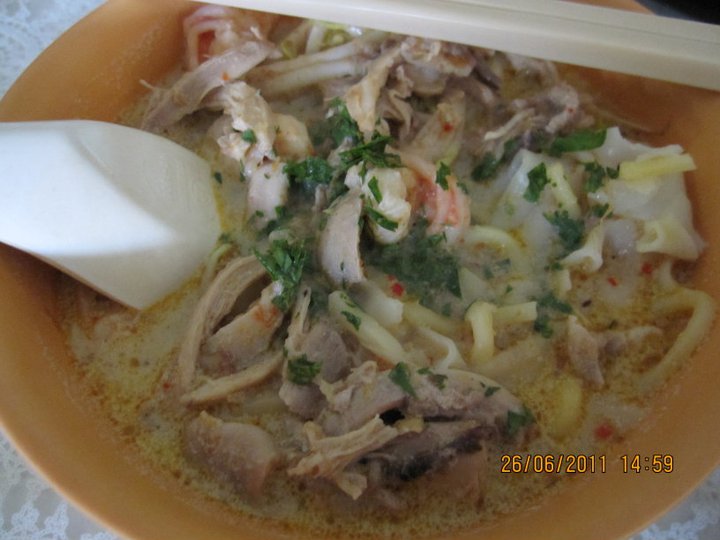
Chicken and prawn Laksa
Been longing for a good laksa, which would you believe it or not, is harder to find in Singapore than you would think. Often its either too oily, or not lemak enough. Given that mine was a 'what's in the fridge' laksa, I had to improvise (e.g I didn't have thick bee hoon, and there wasn't enough yellow noodle, so I just mixed yellow noodle with kway teow). I must say that my dad's fridge is pretty well stocked though, although I would have liked tau pok and fish cake as well. Never mind, after a trip to the supermarket, I added that to the leftovers!

Ingredients (feeds 5)
6 lemon grass, sliced thinly
4 to 5 shallots, skinned and roughly chopped
6 cloves of garlic, skinned
2 big red chillis
1 thumb sized ginger, sliced
4 chilli padi (add more chilli to your own spice tolerance)
150g dried shrimp, soaked in hot water to soften
5 to 6 candle nuts, soaked in hot water to soften
1 tbsp belachan paste
6 chicken thighs
10 prawns, shelled and deveined, sliced into 2
10 to 12 cups of water
200ml packet of coconut milk
200ml milk (full cream preferably. U can use another 200 ml of coconut milk for a better taste if cholesterol isn't an issue)
10 laksa leaves, chopped finely (as a garnish)
3 handfuls of bean sprouts
500g of noodles (thick bee hoon or yellow noodle or both)
5 tbsp oil
pinch of sugar
4 tbsp fish sauce
Optional elements: tau pok, sliced fish cake, hum (cockles)
Method
1) Deshell the prawns, set aside the head and shells. In a hot wok, pour in 1 tbsp of oil and stir fry the prawn heads and shells until fragrant.
2) Add the chicken and brown the chicken. Add the water. Bring to a boil, then down to a simmer.
3) Remove the chicken when cooked (approx 10 to 20 mins, depending on the thickness and size of the thighs). Peel the meat off the bone and shred it, and return the bones to the prawn stock. Simmer the stock for another 20 minutes, then switch off the heat. Remember to skim the stock along the way.
4) In a food processor or pestle and mortar, chop up the items in the following order to make sambal balachan, which serves as the base of your laksa : thinly sliced lemon grass, ginger, dried shrimp and candle nuts (pour the soaking water into the stock pot), chillies, onions, garlic, and lastly, balachan. Items always taste better pounded in the pestle and mortar as the oils esp for the lemon grass are released, but its a long tedious process to get everything into a smooth paste.
5) In a large pot, pour in 3-4 tbsp of oil. Carefully add the sambal balachan as it is very likely to 'spit' once it hits the hot oil. Stir fry everything until the mixture 'splits', aka isn't a smooth paste anymore. It may seem like a lot of oil, but everything gets quickly absorbed. Add 1 tsp of sugar and stir fry until combined.
6) Slowly add the stock ladle by ladle and continue stirring until well combined. Let this simmer for 10 minutes for the spices to infuse into the stock. Add the milk and coconut milk. Bring up to a boil, then down to a simmer for 10 minutes. Switch off the fire.
7) Prepare the noodles by scalding in boiling water for about 3 minutes, and draining. Similarly, prepare the bean sprouts using the same method, scalding them for about 30 seconds before draining.
8) Bring the gravy back to a boil. You will notice that the gravy starts to thicken. Add the shredded chicken, prawns (which only require about 30 seconds of cooking) and fish cake / tau pok if using.
9) To serve, simply assemble. Into a bowl goes the noodles and spouts, then topped off with the gravy. Garnish with chopped laksa leaves. You can also garnish with shredded deseeded cucumber to increase the vegetable content.
Saturday, June 25, 2011
Orh Nee (yam paste)
My 2nd attempt at making Orh Nee. It's actually much simplier than it looks and quite customisable to individual tastes and preferences. The key is in the yam - you need to find a yam that isn't too powdery, otherwise it'll end up quite 'dry', which will require a lot of moisture like oil or water to lubricate. Too much water and it becomes watery; too much oil and it becomes oily. In the end, I used Malaysian or Thai yams, which seem the best. They steam very quickly (only took 10 minutes for 2 large yams!) and the finish was velvety smooth even before adding oil and water. (Unfortunately I accidently deleted the photo! )


Ingredients
2 Thai/Malaysian yams (approx 600g each before removing the stem and external skin)
3 cups of water
10 - 11 tsps of cooking oil (use a neutral flavoured vegetable oil, or lard if you are lucky enough to have it and don't mind the calories! There is no other substitute for flavour)
1 cup of ginko nuts (if using. You can use half a can of ginko nuts or about 150g of fresh ones)
Optional: Sweet potato
3 cups water (this really depends on how much yam there is)
9 to 10 tbsp sugar (again, depends on how much yam and how sweet you want the dessert to be. I made it only slightly sweet)
Method
1) Cut the yam up into big cubes (approx 4cm by 4cm) and steam for 10 to 15 minutes until a fork easily passes through.
2) In a food processor, process the steamed yam and drizzle the 1 to 2 tsp into the funnel everything everything is well combined, smooth and glossy. (I used about 1 tsp for every 10 cubes, as I was using a very small food processor) The consistency should be rather pastey and thick.
3) In a big non-stick pot, combine the sugar and water, and bring to a boil until all the sugar has dissolved. I took the extra step of reducing the water slightly into a slightly syrupy mixture, but you don't really need to.
4) Add the processed yam a bit at a time into the pot, making sure to stir continously to prevent burning. The non-stick is important here. Keep stirring until everything is well combined and smooth. If using ginko nuts and cubed steamed sweet potato, this is the time to combine it in. Only add these 2 elements after all the sugar and oil have been well incorporated into the paste, and don't over stir, otherwise you will end up breaking the ginko nuts and cubed sweet potato.
5) Serve warm.
Sunday, April 24, 2011
Lamb cassarole
In case you haven't noticed, I'm an oven junkie - I love doing things in the oven simply because its minimal fuss. Just prepare, don't even have to leave it to marinate, and just chuck in the oven. Set the timer and off she goes. After about an hour, turn off the oven and let it slow cook in the remaining heat until dinner time.

I saw some lamb on sale and thought that it would be a great way to celebrate my Easter, by treating myself to a bit of lamb. I decided to dunk it with loads to ginger so that it doesn't taste gamey. Unfortunately, it came off tasting like beef, which isn't too bad a result I guess.

Ingredients
400g lamb chunks
1 tbsp rosemary
1 tbsp oregano
2 tbsp light soya sauce
1 tsp sugar
1 tbsp oyster sauce (I would usually use worchester but I don't have that)
1 cubed potato
1 cubed purple yam
Enough water to cover everything
Method
1) Put everything into the cassarole, except the yam. Preheat oven to 200 deg C. Bake at 200 deg C for 20 mins until it starts to boil. Add the yam. (with yam its really very hard to tell, mine 'melted' after the entire time but my spuds were still ok, so it depends on what kind of yam you use)
2) After the first 20 mins, turn down to 100 deg C for another 40 mins. Then turn off the oven and let it cook in the residual heat for another 2 to 3 hours.
Monday, April 11, 2011
Beef casserole
I have wanted to do a beef soup or cassarole for a very long time, but it's only after coming here, where my local supermarket does a pack of stewing beef. It's the cheapest beef I can find, and it's probably the leftover bits that the butcher cuts off (it sure looks that way) rather than cubed stewing beef which is specially cut that way. Other than how it looks, there is an upside. There is a lot of fat, so the beef, once it cooks down, is actually really tender and just falls apart. The fat can be quite easily skimmed off.
What I would add to this casserole? Vegs like carrots, celery and potatoes, but being a single eater, I didn't want to put in that much food. But it would make this casserole more of a stew than the watery soup that my recipe produces.
This is a very simple fuss-free recipe, so I don't even bother doing things like flouring and browning the meat but if you had the time, you should of course do it.


Ingredients
300g stewing beef, cubed
1 tbsp oyster sauce
1 tbsp wine (either chinese or red wine)
1 tsp sugar
1 tbsp dark soya
1 tbsp light soya
Herbs (whatever you like, rosemary, sage, oregano, parsley, etc)
Black pepper to taste
1 to 2 cups of water (sufficient to cover the meat)
Method
1) Marinate the beef. This is not really essential, because the beef will be in the oven for a very long time.
2) Put the meat in a covered casserole, or a dutch oven if you have one. Preheat the oven to 200 deg C and pop in the pot when ready. After 20 to 30 mins, once it has come to a rolling boil, turn down the heat to 100 deg C. Let it simmer gently for 1 hour. Turn off the heat. It is ready to serve, but what I do (to save electricity) is to turn off my oven and let it continue cooking in the residual heat, where it will happily do so for up to 4 hours, and it is still warm enough (not boiling hot) to serve for dinner.
3) Serve with rice, garlic bread, or mashed potatoes - whatever you like!
Saturday, April 09, 2011
Cheat's chicken rice
I have been doing a lot of microwaved meals, mostly because it's quick and easy and least amount of fuss, and it's difficult cooking for 1 person. I discovered this chicken rice equivalent quite by accident. You will see why I say 'equivalent' later. Don't expect really premium quality bak zhum gai type of chicken, this is really more about taste than texture, because there's only so much the microwave can do! Whenever I cook this and my flat mate steps into the apt, she never fails to say "Wow, smells wonderful!" and she's a vegetarian!

Ingredients
3 chicken thighs
1 tbsp sesame seed oil
1 tbsp light soya sauce
1 tsp chopped garlic
1 tsp chopped ginger
1/2 tsp sugar
Black pepper to taste
1 tbsp water
Vegs (e.g. broccoli, cabbage) optional - if adding veg, you need to add more water
1 portion of rice, cooked

Method
1) Marinate the chicken with all the ingredients for at least 1/2 hour.
2) Put everything in a microwave casserole. Microwave at 30% for 20 mins, then turn up to 70% for 3-5 mins. The lower the heat, the more moist your chicken will be but it wil naturally take longer. Each microwave's voltage differs, so you really have to check whether the chicken is cooked, and adjust accordingly. To do this, pierce a fork into the thickest part of the thigh, usually next to the bone, and see if the juices run clear. You can also do it at 10 mins for 50% power if that's quicker. It's all about experimenting with your own microwave to get the best result that works for your microwave.
3) At this point, you're asking, so where is the rice? What happens is that the chicken juices will flow out. You add the rice to this (warmed up if necessary) and it will absorb the juices and it really tastes like chicken rice!!!! See why I said 'chicken rice equivalent'? Because if yo know how chicken rice is really cooked, you know that the rice is usually fried in chicken oil then cooked in chicken stock!
Thursday, April 07, 2011
Autumn chicken soup

I have always loved soups, but no where is this more appropriate than during my first autumn in Oz. Somehow its just very nice and earthy to drink warm soup during a cool evening - the feeling of being home once again as the warming nourishing soup fills my tummy. This isn't my usual clear soup, it has a lot more packed into it in terms of seasoning - makes up for the loneliness and emptiness and lack of ingredients!
Ingredients
1 tbsp light soya
1 tbsp fish sauce
1 tsp sugar
1 tbsp oyster sauce
1 tbsp garlic
1 tbsp ginger
2 cups water
3 pieces of chicken thigh, deskinned
Method
1) Marinate the chicken with the above. I don't have rice wine, so I used oyster and fish sauce to add a different type of flavour, but boy do I miss my chinese rice wine!
2) Transfer to oven cassarole covered dish and bake. It can either be a slow bake at low heat or a quick one at high heat - the outcome is very different! For this one, I used 200 deg C until it boiled, then turned off the heat and left it in the hot oven for the next 1 hr. It was still boiling when it came out of the oven!
Monday, December 20, 2010
Beef and bean stew
Inspired by Brazalian Fejioda, this is certainly a lot healthier than the real version. There are many possible variations including changing the beef marinade, type of beans used and vegetables used.
Ingredients
800g stewing beef, cubed
1/2 cup flour
1 can of cannelloni beans, drained
2 carrots, cubed
2 leeks, sliced
1 onion, chopped
1 clove garlic, crushed
3 rashes streaky bacon, chopped
Marinade for beef
1 tsp mustard
1 tbsp Worcester sauce
herbs (I used rosemary, sage and parsley, you can also add a bay leaf to the stew)
1 tbsp soya sauce
1 tsp brown sugar
1 tbsp sherry
Method
1) Brown the beef cubes. Set aside.
2) Pour away the excess oil, and brown the bacon. Add the onions and leeks and sweat them until soft.
3) Add the carrots, beef and beans. Top up with enough water to just cover the beef.
4) Bring to a boil, then down to a simmer for a hour, or less if you're using a pressure cooker. I had a pressure cooker failure
5) Serve immediately with crusty bread, or let the stew flavours develop overnight.
Ingredients
800g stewing beef, cubed
1/2 cup flour
1 can of cannelloni beans, drained
2 carrots, cubed
2 leeks, sliced
1 onion, chopped
1 clove garlic, crushed
3 rashes streaky bacon, chopped
Marinade for beef
1 tsp mustard
1 tbsp Worcester sauce
herbs (I used rosemary, sage and parsley, you can also add a bay leaf to the stew)
1 tbsp soya sauce
1 tsp brown sugar
1 tbsp sherry
Method
1) Brown the beef cubes. Set aside.
2) Pour away the excess oil, and brown the bacon. Add the onions and leeks and sweat them until soft.
3) Add the carrots, beef and beans. Top up with enough water to just cover the beef.
4) Bring to a boil, then down to a simmer for a hour, or less if you're using a pressure cooker. I had a pressure cooker failure
5) Serve immediately with crusty bread, or let the stew flavours develop overnight.
Sunday, November 14, 2010
Steamed milk egg pudding
Tried this recipe from Cotter Kathy154. Works quite well but I didn't have a chinese rice bowl so used 2 coffee cups, which eventually became 3 in order to accommodate all the liquid. The pudding wasn't very sweet, not as sweet as we get in HK and because of the egg yolk, it was a lot more creamy than the usual egg white "dan lai" that I'm used to, but nice too.


Ingredients
2 eggs
160ml*2 milk (ie 160ml of milk for each egg). You can use skimmed or full cream, full cream would make it creamier although I used skimmed and it was still very creamy.
1 tsp sugar (didn't make it very sweet, might add another tsp next time for every 2 eggs)
Method
1) Beat the eggs and add to the milk and sugar. Whisk well.
2) Strain the mixture into the cup. Use a teaspoon and skim off the bubbles. This is important to ensure that the surface is smooth and not 'pock-marked'.
3) Get ready a pot with boiling water, and a steamer.
4) Steam for 13 to 15 minutes at low heat until set. Test for done-ness, if it's still not set, steam for a bit longer.
Saturday, October 23, 2010
Fried Vietnamese rice noodles
I found these miracle rice noodles, which is like bee hoon except its flat noodles. What's so miraculous about it is that you don't need to boil the noodles. All that's needed is to either soak the noodles in boiling water for 2 mins, or in normal water for 8 minutes. Just like bee hoon, but the difference is that it doesn't turn to mush so easily.
I initially wanted to do this as a vegetarian dish, but my family isn't very vegetarian. So in went a few frozen prawns, although you can just as easily add some char siew or minced pork.

Ingredients
1 packet of Vietnamese flat rice noodles
1 packet of baby asparagus (about 200g)
1 packet of bean sprous (about 100g)
1 carrot, sliced thinly like little matchsticks
1 cup of frozen prawns
2 eggs
1 onion, chopped
1 garlic, minced
1 tbsp oil
1 tbsp oyster sauce
1 tsp Maggi chicken stock
a sprinkle of sugar
1 tbsp fish sauce
1 tbsp chinese cooking wine
1 tsp sesame seed oil
1 tbsp rice flour
1/4 cup water
Method
1) Soak the noodles as stated on the packet.
2) This recipe requires slightly more oil that normal to fry the noodles, so don't be overly alarmed. Fry the onions and when browned, stir fry the carrots and asparagus.
3) Fry the eggs and scramble them. Add the marinade, including the water and rice flour.
4) Add the frozen prawns and half the water and and cover.
5) Once cooked (approximately 3 to 5 minutes), add the noodles and carefully toss with 2 spatulas. Try not to break up the noodles if possible. Add the remaining water. Try not to over-mix the noodles but the noodles should still be al dente and moist enough.
6) Add the sprouts, incorporate well and serve immediately. Sprouts don't need much cooking even 10 seconds is enough. It will continue to cook in the heat.
I initially wanted to do this as a vegetarian dish, but my family isn't very vegetarian. So in went a few frozen prawns, although you can just as easily add some char siew or minced pork.

Ingredients
1 packet of Vietnamese flat rice noodles
1 packet of baby asparagus (about 200g)
1 packet of bean sprous (about 100g)
1 carrot, sliced thinly like little matchsticks
1 cup of frozen prawns
2 eggs
1 onion, chopped
1 garlic, minced
1 tbsp oil
1 tbsp oyster sauce
1 tsp Maggi chicken stock
a sprinkle of sugar
1 tbsp fish sauce
1 tbsp chinese cooking wine
1 tsp sesame seed oil
1 tbsp rice flour
1/4 cup water
Method
1) Soak the noodles as stated on the packet.
2) This recipe requires slightly more oil that normal to fry the noodles, so don't be overly alarmed. Fry the onions and when browned, stir fry the carrots and asparagus.
3) Fry the eggs and scramble them. Add the marinade, including the water and rice flour.
4) Add the frozen prawns and half the water and and cover.
5) Once cooked (approximately 3 to 5 minutes), add the noodles and carefully toss with 2 spatulas. Try not to break up the noodles if possible. Add the remaining water. Try not to over-mix the noodles but the noodles should still be al dente and moist enough.
6) Add the sprouts, incorporate well and serve immediately. Sprouts don't need much cooking even 10 seconds is enough. It will continue to cook in the heat.
Subscribe to:
Posts (Atom)

-
This mantou dough XiaoHong uses a different method with single proof by adding the yeast AFTER the dough has been kneaded. Ingredients 50...
-
 I have tried different ways to cook glutinous rice and stir fry it. I tried the IP version several times but I never got it right. It was a...
 -
There are several videos now trending about putting flour in oil when the oil is cold and then putting in bite-sized pieces. Magically the c...